Thursday, 16 February 2012

Freezing Beer

Take a look at these two beers? They're from the same fermenter, used the same yeast and went into two cornies that were sanitised with the same sanitiser. 


So what's the difference?


Well, I left the one of the right outside on the patio during the latest cold snap and when I'd remembered I'd done it, the beer had frozen slightly so I brought it in the conservatory. 


I think I'm going to do this a bit more often. Incidentally, blindfolded, I couldn't tell the difference between the two.

Friday, 20 January 2012

AG #47 Honey Hill Wheat

Ever since I bumped into a bee keeping local beer lover we've discussed making a honey wheat beer and sharing the batch and, this last holiday, I eventually got round to it. 


The problem with adding honey to a beer is that honey tends to harbour rather a lot of wild yeasts. You can kill them by boiling but the simple act of boiling tends to drive off the honey aroma. Some brewers add it to the fermentation after the initial high krausen has died down and others prime the beer with it. 


Being a bit of a prat, I decided to do all three. I added a jar and a half (about 350g) during the boil, a jar (227g) at the back end of the ferment and primed with 164g. If you're wondering why I've primed with so much sugar, an American homebrewer I've been speaking to on Twitter directed me to these extremely useful pages on priming solutions and how to calculate the amounts of sugar in them.


So, with the Honey Hill Wheat, I struggled with the volume of CO2 - it's not a measured term I've ever come across before. Turning to the table at the bottom of the page on priming solutions I've used the value 2.7 for American Wheat as I figured it was at the low end of fizzy. Once I decided that, the rest was pretty self explanatory and I ended up dissolving the honey into a little boiling water and put it in the brewfridge to warm condition for a week


3kg Pale Malt
3kg Wheat Malt
550g (ish) Honey + 164g for priming.


25G Hallertauer Hersbrucker 4%AA @ 60min
10g Sorachi 12.2 %aa @ 15 mins


Yeast Safbrew WB-06


OG 1055
FG 1006
ABV% 6.46
IBU 15.8
Brewlength 16L

Monday, 2 January 2012

Three Brewery Mods

Oh the joy of a bit of chill out time over the holiday period; not only did I get four brews on but I also managed to make some much needed modifications to my brewery.


I've been meaning to get round to these for ages but have been simply waiting for the time, or in some cases the money.


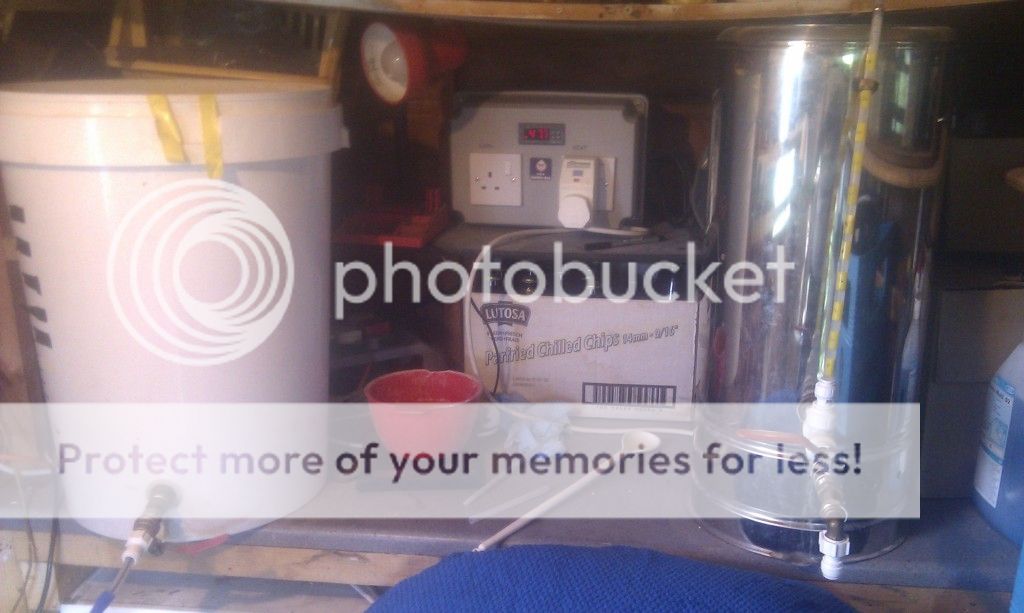
Chillers Plumbed in Parallel


I've got two stainless steel coiled immersion chillers and, until I discovered a spare JG speedfit T-piece in my box containing odds and sods, I'd been plumbing them in series. I've got two because they have a fairly small surface area, much smaller than the standard copper immersion chillers, and I have always plumbed them in series, that is with the cold water going into the bottom of the first chiller, out of the top, and then in the bottom of the second one, etc. 


It has often occurred to me that if I have them plumbed in parallel (i.e. via T-pieces) I could get a quicker crash cool, either by having them both cooling from the bottom up, top down or one of each.  It's too soon to say whether or not this set up cools beer quicker but at least I've got a little more flexibility. I've also taken the opportunity to connect the chillers through the lid of the boiler. This has the effect of suspending the chillers directly above the hop strainer so I should be able to close the lid of the boiler without bending the plastic pipe on the top and risk springing a leak into the wort. 


Boiler Exhaust


One of the things I've had to deal with regarding brewing in the shed is condensation, and I've realised that not only is it ruining the shed but it's a potential source of infection as well, especially if condensation dripping from a cobweb filled ceiling drips back into a cooling boiler. 


So I've bastardised a tap set up from an old and broken hot liquor tank and drilled a hole in my boiler lid for a tank connector and popped a ball valve and 90 degree bend so that the the exhaust can go out of a hold I've drilled in the side of the shed. 


I've added the ball valve for a couple of reasons; firstly I can close it when I add flame out (aroma) hops so I can stop the aroma escaping but also because I am planning to connect the water feed into the shed through the exhaust and I want to be able to shut it off when necessary. 


Motorised Wort Pump


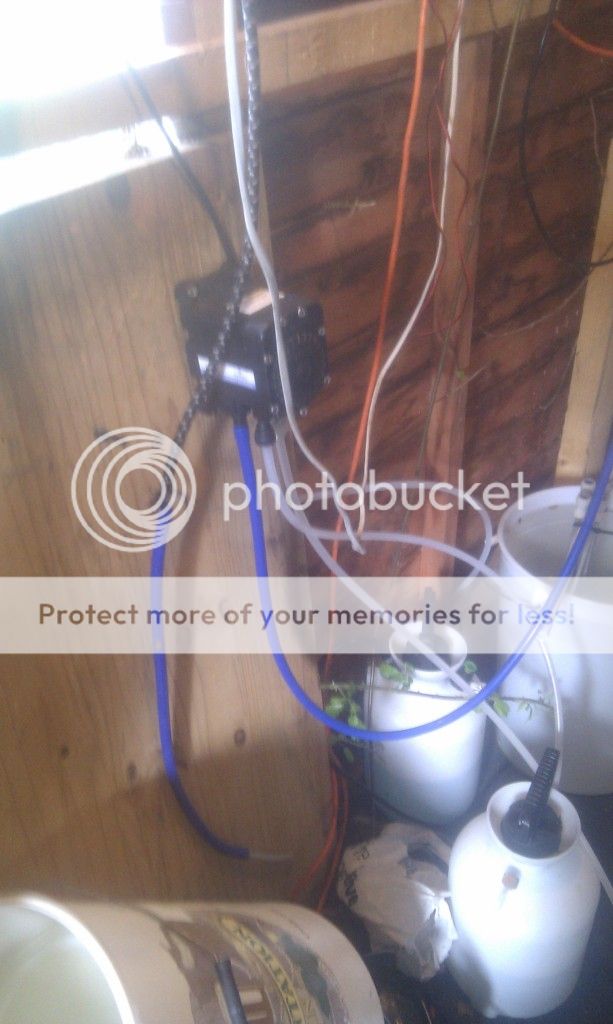
I've written about my wort pump before. Until now I've been operating the flojet pump with a hand operated pressure spray. As friends who have brewed with me, pumping 38 litres of wort between mash tum and kettle is no fun at all but I wasn't about to spend £100+ on a compressor to operate the pump. 


So when he was Brew Monkeying for me one day, my good friend Matt suggested I modified a tyre inflator to do the same thing. I was a little reluctant at first but when I went to check my tyre pressures and realised the hose on my inflator had broken, I realised I had nothing to lose. 


I cut off the tyre adaptor with a a pipe cutter and then heated some silicone tubing in warm water to join the high pressure hose to the 3/8" OD beer line that goes into the flojet pump. The compressor/inflator works on a 12v DC cigarette lighter adaptor so I cut that off and connected it to a rechargeable 12v battery that I used for another, now redundant, project; it even fits in the recess of the pump so it's all rather small and cosy. 


I've tested the pump and it seems to recirc 30 litres of water in no time,  I'll be testing it at the weekend so I'll be sure to let you know how the new modifications performed. 

Thursday, 29 December 2011

Why I'm Not Opening a Brewery Any Time Soon

It's a question I'm often asked, and I was asked again when I was interviewed by the local paper for this story. "Would you like to do it for a living?"


Quite apart from not being good enough, I love the way people assume there's little or no difference between a hobby and a professional operation; then there's the current economic climate which is hardly conducive to new business development. Yet there are new breweries opening up every month it seems. In Kent alone, the number of breweries (including brewpubs) has doubled in the last two years. 


Yet we are constantly hearing that pubs are closing at an alarming rate. So, let me work this out for a moment. You've got more manufacturers competing in a shrinking market. Where are these breweries going to sell their beer?


Seriously, I can see a saturation point arriving in the not too distant future.


I work in the healthcare industry for a company that sells medical consumables to care homes. We're are not unique in what we do but we succeed because we have what, in management speak is known as a USP or a unique selling proposition. If you have a USP you do not have to deal on price; this is expressed much more eloquently by Tandleman and Hardknott Dave on their respective blogs. How many of these breweries have a USP? How many of these breweries will still be trading this time next year?


So unless you have your USP you are competing in an increasingly competitive marketplace where price and progressive beer duty are your only weapons, you've then got transportation costs, casks to buy (and more importantly get back from the pubs) and late payers to deal with. 


So, if you could cut out the transportation costs, cask issues and late payers, all you've really got to come up with is a point of difference; whether that is in cask, keg or bottle, it is possibly viable. Yup, I'd bodyswerve a new brewery but a small scale brewpub, in the right location, I'd jump at (if I had the readies).

Friday, 23 December 2011

Beers I'd Like to Brew in 2012

Given my travails with infection over the past year, I guess the short answer is most of the ones I've buggered up in 2011 but there's more to it than that. 


During my home brewing odyssey I've developed a love of stouts partly, it has to be said, because they appear to be the only beer I can't ruin. I think a lot of it has to do with the water here in East Kent which suits stouts perfectly; when I was doing water chemistry (which I can't be bothered with until I've sorted out my infection woes) I barely had to change my liquor at all. 


I've been inspired by Bristol Brew Co's 12 stouts of Christmas (none of which I've tried) and it has occurred to me that it could end up like the shrimp scene from Forrest Gump; Oatmeal Stout, Toasted Oatmeal Stout, Imperial Stout, Coffee Stout, Vanilla Stout, Bourbon Stout, Vanilla Bourbon Stout, Coffee Vanilla Bourbon Stout.... und so weiter. 


So Coffee and Vanilla (separate) stouts are on the menu for next year and I might get round to ageing some on oak chips soaked in bourbon. 


I'll also be revisiting the Red Spider Rye and #IPADay recipes as I think these are cracking recipes I never got to drink because of my dirty downpipe (ooh matron). One thing I'll probably not be doing is bottling much. I'm fed up with it; it is a complete ball ache and I love my cornies too much. 

Wednesday, 21 December 2011

West Coast Stella Mark 2 Recipe

It's a little early to re-evaluate the recipe for a beer which hasn't even had time to condition yet, but I just can't help myself. 


The beer needs a slightly higher alcohol level to balance out the hops and, I think, some caramalt or light crystal to add a little more colour and body. 


To compensate for the extra alcohol, I've upped the late hops by 10g.


Grain Bill (based on 70% efficiency 19L brewlength)


5.5kg Maris Otter
450g Carapils
450g Caramalt
450g Aromatic


Hops
10g Stella (16%AA) FWH
10g Stella @ 30mins
15g Stella @ 20 mins
15g Stella @ 10 mins


Protofloc @ 5 mins
US-05 Yeast

Sunday, 18 December 2011

A Year in Home Brewed Beer

December is traditionally a time to reflect on one's performance over the preceding 12 months; we see reviews of the year, sports personality of the year, record of the year, golden pints and so on. This year is my first full year of all grain brewing so, while the "Gone for a Burton" is mashing in, I thought I'd take the time to review the beers I've brewed in a chronological order, work out which were the best, share with you the (sadly large) list of failures and, in true Nick Hornby blokey listing fashion, rank them in a top ten. I appreciate that reviewing my own beers does seem rather self indulgent but, on the other hand, doing it in this way, allows me to see the errors of my ways so, hopefully, other home brewers can benefit as well. 

January

I started off on New Year's Day by making a St Petersburg Clone, complete with Peat Smoked Malt and Sorachi hops. In all honesty the version I did in October had better balance (this one had too much smoked malt flavour although they followed an identical recipe) and a lovely mouthfeel. It's one of my favourite beer styles, even though this example isn't the best ever. However it did improve throughout the year. This example was bottled, I'm not sure a keg version would be as good. 5/10


The weekend of the 29th January must have been a busy one because, according to the brew diary, I did two brews in one day. One was Starvation Point smoked porter and the other was a Whispering Bob. This was the initial incarnation of the Starvation Point; I did slightly different versions later in the year. Again, as with the St Petersburg, the porter benefited for some ageing. 6/10.

Whispering Bob was a different story, I quickly realised that I'd hit upon a winning combination with the grain bill when I made it the previous year. It's basically a combination of carapils, aromatic, crystal and pale malts. Combine that with US-05 and you've got a platform for hops like Simcoe and Amarillo to really shine through. 8/10

February

Just the one brew this month but it was a parti-gyle brew. I took my basic Whispering Bob recipe and did a strong beer using T-58 instead of US-05. The small beer I did with Sorachi and Citra instead of Amarillo and Simcoe (but used US-05). From memory the T-58 version took an age to come into condition but when it did, the yeast seemed to accentuate the caramel notes of the malts. The Sorachi Citra was unbelievably sharp until the hops died down about three months later.  T-58 7/10 Sorachi Citra 6/10.

March

Just the one brew in March too. This was an English Pale Ale I did for Easy Home Brew in Ashford; the idea was to release it as a full mash kit but nothing came of it in the end, still it was a decent beer and one I did later in the year to good effect. 7/10

April

Looking back on the brew diary I can see that this is when the infections started coming. At first I assumed it was due to water because it only seemed to be affecting my pale beers but I'm pretty sure it is down to poor sanitation in the tubing exiting the boiler. South Pacific a pale beer hopped with Green Bullet, Pacific Gem and Nelson Sauvin - straight down the drain. 0/10 However the Starvation Point porter was a completely different story. I did two versions of this with the kegged one being matured for three months over bourbon soaked oak chips. Bottle 6/10 Keg 7/10. I also had another attempt at the South Pacific but, although it made it as far as the bottle, it was also undrinkable. 0/10
        
May

This was my first attempt a mild for May. Sarah Hughes Dark Ruby Mild. Apart for using too much crystal malt, I now suspect this has some kind of infection, or at least a very strange back taste. The reason for this is that I over pitched a second batch of Easy Home Brew EPA straight onto the trub, this gave a very odd straw taste not dissimilar to a Belgian Farmhouse ale. I called it my unintentional lambic. Dred Penguin observed that if I'd called it a Belgian Farmhouse Ale rather than an EPA I'd be considered a "bloody genius". If I liked Belgian Farmhouse Ale it would have got more than the 2/10 I'm giving it. The SHDRM also gets a 2/10

June

June was a better month by far with three brews, none of which were infected. First up with my first attempt at a Red Rye Ale, I called it Double A because I used Apollo and Amarillo hops.  I sneakily chucked a handful of Simcoe hops in the dry hop. Amarillo and Simcoe are pretty much the best hop combo I've come up with this year. 8/10

The Oatmeal Stout recipe I lifted from the Beer Smith website has rapidly become a staple brew; I've brewed it four times now but I've given up bottling it as most of them seem to gush even if I under prime. 7/10

Possibly the best of the lot was the Horsebridge Imperial Stout Again I lifted the recipe from Beer Smith before adding Dark Muscovado sugar and Carafa 1. This was bottled in 58 Budweiser bottles and many of them given away to friends who seemed to like it. 9/10.


July

Only two of the three July brews were drinkable with the IPADay brew going the way of the drain. 0/10. 

The other two were tweaked versions of my first attempt at a Rye Ale - but this time with Cascade and Centennial instead of Apollo and Amarillo. This one had some funny stuff growing in the fermenter so I kegged it quick to get it under CO2. It tasted ok but not a patch on the double A version. 5/10

Probably the best of the three was an elderflower infused version of the Easy Home Brew Pale ale which we ended up calling Elders and Betters. I swapped out the Fuggles for Bobek and added 80g of locally grown Elderflowers 15 minutes from the end of the boil. This was brewed for a mate's party and must have gone well because they drunk one and a half cornies worth. 7/10.

August

Because I was in Ireland and working at Easy Home Brew for most of August there was only the one (double) batch of Oatmeal Stout made which tasted exactly the same as the previous version so gets a 7/10.

September

This month I managed a crack at a lower abv Whispering Bob for another party and what became known as School Night Ordinary Bitter. This was partly motivated by the need for a session beer (I hang my head in shame) and partly to use up old ingredients. The Saaz and Cascade combo was interesting but the whole beer had a slightly sharp taste. 4/10. The Whispering Bob that came out about 4.5% again went in a single evening, yes it was some party in case you were wondering. 7/10.

October

October (and the beginning of November) saw my greatest disasters. First of all my HLT broke when brewing Ringwood Old Thumper with Clokey74 so we didn't acheive the sugar conversion in the mash which meant we were about 2% ABV light, then the whole brew got infected anyway. 0/10.

November

I had such high hopes for Red Spider Rye but that went the way of the drain but I think it is a good recipe so I'll be brewing it again in the New Year. 0/10. The Styrian Pale was a step in the right direction inasmuch as it wasn't infected. However whether it was because I used amber malt instead of crystal S33 instead of S04 or just that my boil was weak, I just can't seem to get it to clear. Tastes ok though. 5/10.

December

Having established that the cause of my infections is 95% likely to dirty tubing, with other possible causes being brewing in the shed itself or a dodgy yeast split. The first two brews in December are coming along nicely. The most recent Oatmeal is the best yet, possibly due to the inclusion of 20g Willamette in the dry hop but most likely due to the fact I'm just so relieved to get a drinkable beer. I was going to give it 8/10 but perhaps the dry hop is only worth half a mark. 7.5/10. 

Perhaps what might turn out to be the best beer might have to be saved until next year. The West Coast Stella tastes pretty insane at the moment. I'm not going to score it because it has only been in the keg 24 hours and it hasn't had the opportunity either to clear or develop.

Conclusions

Probably the most important lesson to learn here is "Keep It Clean"; think how much more lovely beer I'd have if only I'd followed that maxim. So, to the top ten, in time honoured tradition in reverse order.

10. Starvation Point Smoked Porter (Bottled)
9. Whispering Bob with T-58
8. Standard Oatmeal Stout
7. Easy Home Brew EPA
6. Elders and Betters (with Styrians & Elderflowers)
5. Starvation Point Smoker Porter (with bourbon oak)
4. Oatmeal Stout (w/Willamette)
3. Double A Red Rye
2. Whispering Bob (Original)
1. Horsebridge Imperial Stout