Sunday, 15 July 2012

Final Hot Liquor Tank Modification

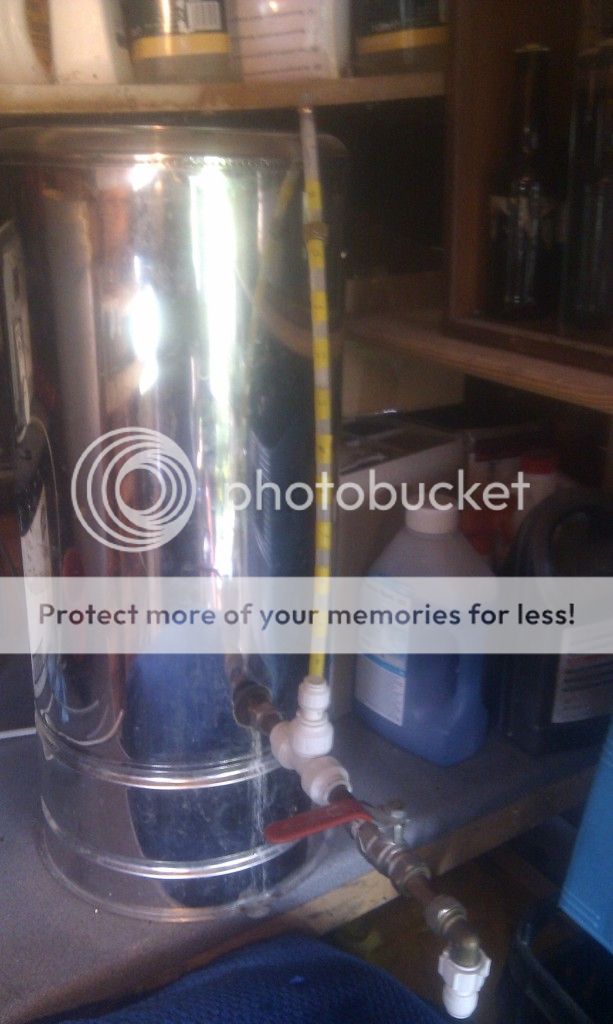
As I alluded to in an earlier post, my final modification to my hot liquor tank is the fitting of a sight tube. Why do I need one? As the HLT is made of stainless steel there's no way of accurately measuring the amount water going into the mash tun, either for doughing in or sparging.


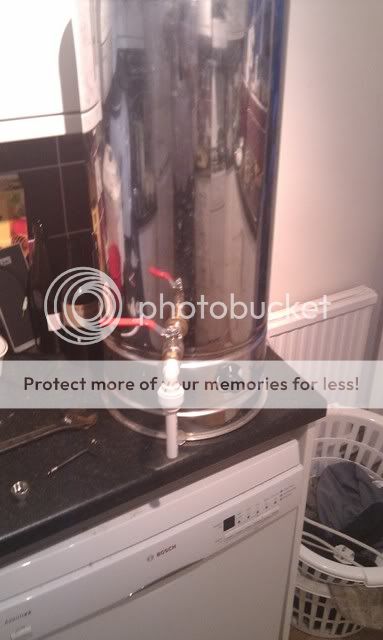
My aversion to drilling holes in my gear meant that I was looking to integrate the sight tube into my existing tap fittings. My aversion to spending any more than I have to meant that I wanted to use existing fittings which meant a combination of compression and speedfit fittings.


I had a 15mm speedfit T piece in my possession so I added a 15-10mm reducer and a bit of 10mm OD beer line and put the whole caboodle in between the tank connector and the tap. 


Having made sure it was finally watertight, it was time to calibrate the sight tube. There were a couple of problems; firstly the beer line, being made from nylon isn't as straight as some clear polycarbonate tubing which I plan to get from here. The other issue was, due to the extra height added by the reducer on top of the T-piece, there are eight litres of water in the HLT before it registers on the sight tube. The second problem isn't really an issue because I hardly ever need to add an amount of water that small. 


This set-up is perfect for brewing a cornie's worth (19L) of beer. For larger brewlengths, I can always store the water in my boiler and transfer one to the other.

Tuesday, 12 June 2012

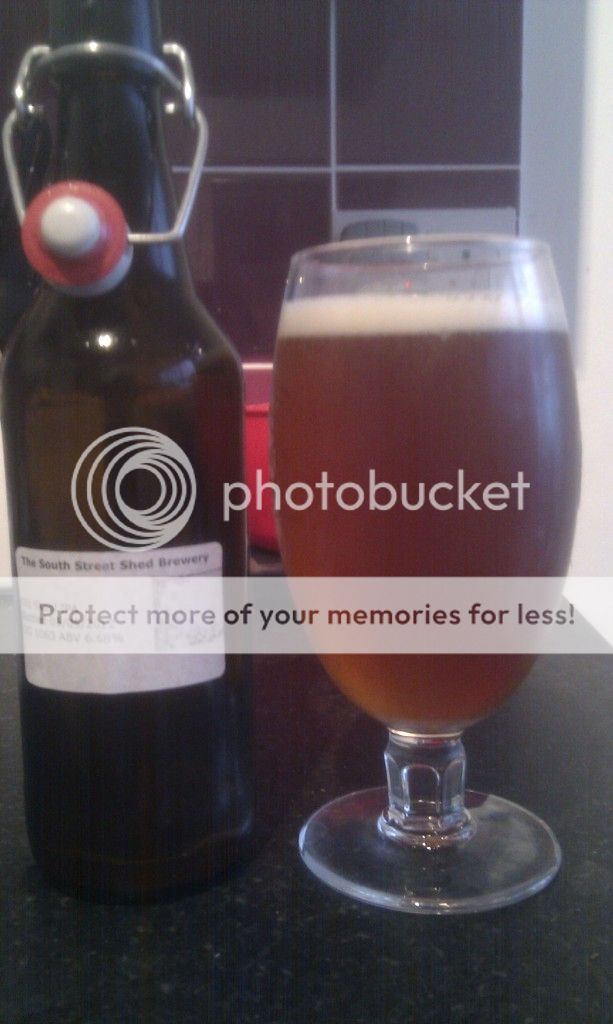
Beer Porn - Old Skool IPA

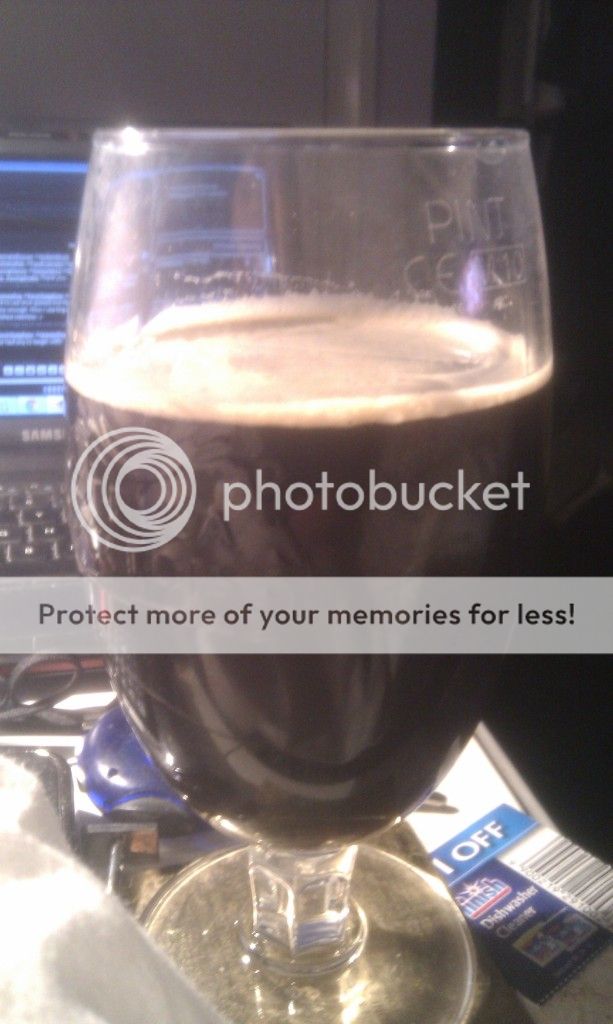
A long time since I've done a beer porn post. This one is my first attempt at a proper IPA with Fuggles and Goldings and a bit of demerara sugar. 


If I'm honest, it needs even more hops - both at the bittering stage and the dry hop. However there are just enough in there to suggest it's worth doing again. I'll see if I can avoid the chill haze this time as well (although it makes bugger all difference to the taste). 

Wednesday, 30 May 2012

Hot Liquor Tank Mark Two

Some time ago my I burnt out the temperature switch on my hot liquor tank whilst brewing Ringwood Old Thumper with my good friend Clokey. It was a far from trouble free brewday and the brew ended up getting infected which was a real pain. 


Still, I'd shown Clokey the plage on PDTNC's blog featuring his mango chutney barrel that he turned into a hot liquor tank and he soon set to wok doing the same for me (just as well really because I'd probably have blown the house up). 


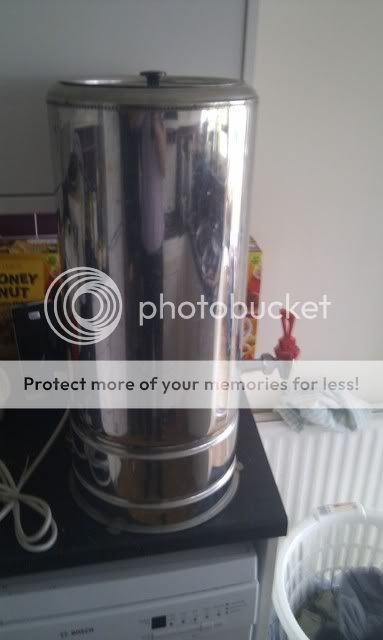
So, to recap, this is the boiler/tea urn which I picked up from a care home that was chucking it out (due to a failed PAT test on a cable with a cut in it.)  


I set about removing the tap myself and replaced with 15mm compression fittings (tank connector/ball valve etc). I also fitted a hop strainer so that I could use it for small brews (max 15 litre) but I found the 3kw element a bit meaty for what I wanted to do and kept having boil overs. 


Many (most) home brewers manage perfectly well without an HLT but I found that my efficiency went down from about 75% to about 69/70%. Whilst this isn't a big deal. I'm assuming this is to do with the fact that the elements in my boiler are too far off the ground to get an even temperature. As the element is fitted to the bottom to the HLT this isn't a problem. I can also fit my fly sparge adapter onto the tap, which is a bonus. 


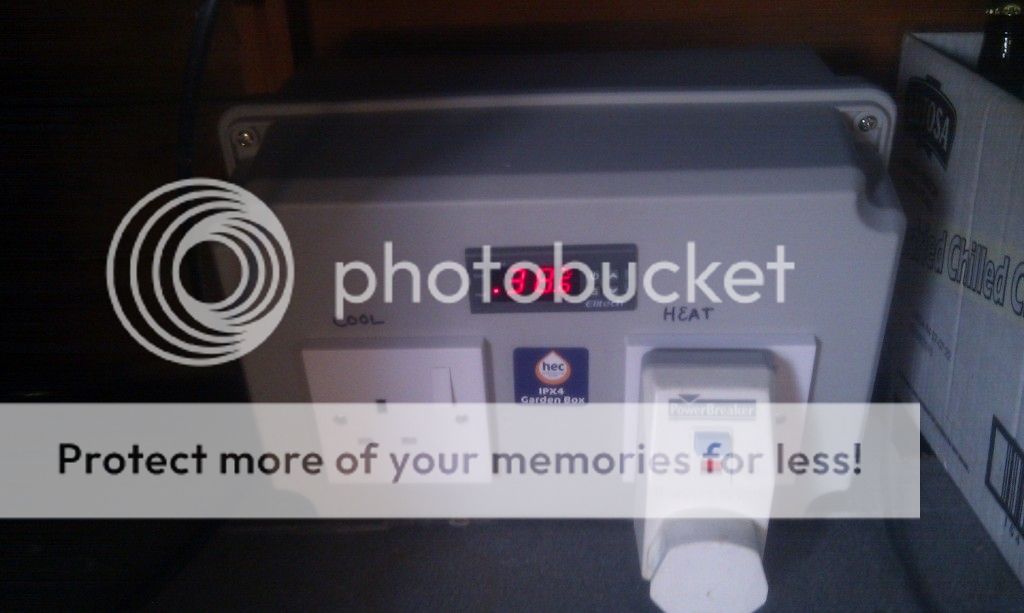
So, whilst the element, container and pipework were largely ok, we needed to find a means of controlling the temperature. Since imitartion is the sincerest form of flattery we decided to copy PDTNC and went for a project box, STC-1000, probe and two plug sockets. The only difference between his and ours is that ours has to switch a 3kw element so we (I don't really know why I'm saying we all the time, I did nothing) added an external relay to switch the element. The only thing Clokey didn't fancy doing was drilling the hole for the probe so for that I took the HLT to my good friend Quixoticgeek a fellow member of East Kent Amateur Brewers who's a dab hand at drilling holes in stainless steel.


I should have taken some pics of her at work because, with no special drill bits but with a can of WD40 she drilled a 10mm hole for the probe with very little fuss indeed. 


So today I started the leak/heat test. I filled the HLT with 25L of water at 20c. It took 40 minutes to heat up to 80c and the hole for the probe remained completely watertight. Sadly the one for the tap has worked loose over time but a strip down of the parts and some PTFE tape should sort that out. The last modification to the HLT will be the fitting of a sight tube which will allow me to tell how much water has gone into the mash/sparge but that will have to wait for another time. 


Sunday, 29 April 2012

First Crack at an English IPA

Yeast seems to have got over excited
So much has been written about this beer style I'm not sure any article I could write would add to the sense of what an Old School English IPA should, or shouldn't, be. 


My attempt is to try and emulate Meantime Brewing's take on an IPA as it is one of my very favourite examples of a strong, bitter beer showing off the East Kent Goldings at their very best. 


My recipe basically uses Fuggles for bittering with EKG's late and dry. I'm looking for a beer between 6 and 7% abv and a bitterness of around 45-50 IBU. Because I'm using fuggles (5.22%AA) for bittering that's quite a lot of hops (and a fair few twigs) but it didn't seem to give me much liquid loss coming out of the boiler. In fact I ended up with 24L @ 1063 instead if 23L @ 1067. A combination of that and pitching two packs of yeast probably explains why I woke up to a yeast explosion this morning. I am ruing the demise of my original 30L Hambleton bard fermenter which is scratched beyond reasonable use these days and thus only gets used for holding spent grain. 


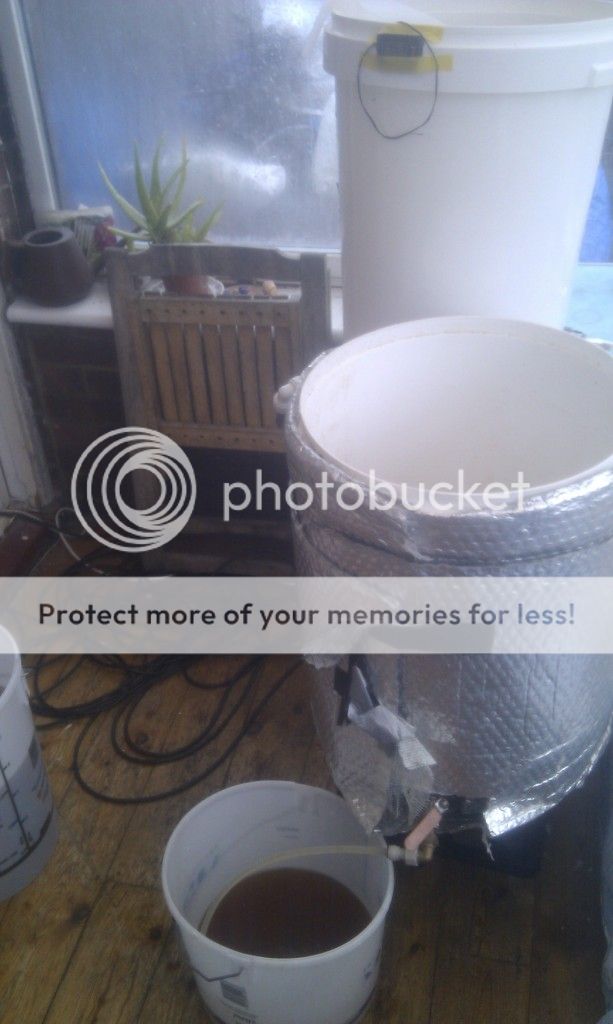
Doughing in
Anyhow, as I write, the yeasties are munching their way through the wort. I'm going to transfer to a secondary bucket relatively early, partly because I'm going to dry hop with loads of lovely EKG's prior to bottling next weekend or early next week. Yes, I'm not going to keg this beer (to be honest I'm already dreading the faff that is going to be bottling but I really feel this beer is going to benefit from being in the bottle for an extended secondary fermentation period). 


The recipe is based on my ordinary pale ale recipe but beefed up with a bit of demerara and carapils instead of wheat malt or torrefied wheat. This is mainly because I have a wheat intolerant friend who I want to try this beer. The brewday was not without problems; I had to brew indoors due to the stupid English weather and one of my elements blew (probably due to the sugar in the brew that seemed to stick to the element) so I'm going to have to take the boiler apart to clean both the elements again. This will cause a problem all its own because you can bet your life that, when I put the elements back in situ, there'll be a leak. 


First Wort Hops, Demerera Sugar and Yeast
Recipe. 


Brewlength 24L
Bitterness 45 IBU
Colour 15 EBC
Original Gravity 1063


Grain Bill


6kg Pale Malt
200g Crystal (120 ebc)
300g Carapils


First Runnings
Boil Ingredients


30g Fuggles First Wort Hop (5.22%AA)
500g Demerera Sugar
30g Fuggles @30 mins
30g Fuggles @20 mins
30g East Kent Goldings @ 15 mins
30g Fuggles @ 10 mins
1 protofloc @ 5mins
30g EKG @ flame out (80c steeped for 30 mins)


Yeast 
1 x Windsor
1 x S04

Thursday, 19 April 2012

Tap East "Coffee In The Morning" Brewday

Back when I re-commenced home brewing in March 2009, like a lot of people, I turned to a couple of the many home brewing internet forums for advice. On one of these I found James Wilson and Phil Bird both of whom started at pretty much the same time as me and, through the power of the internet, we all became friends, met up and exchanged beers. 


Phil and Jim inspecting the brewery control panel
Some while later Jim made the career move that probably every middle aged home brewer wants to make (but mortgage/kids etc. prevents them from) and joined Brentwood Brewery as an assistant brewer. Since then I've watched his progress (and drunk some of the beers he had a hand in developing) and I was delighted to find out that he had been appointed head brewer at Tap East. Let's face it, when the Olympics kick in, that place is going to be buzzing and his beers, for better or worse, are going to be scrutinised by anyone who doesn't actually want to drink Heineken. Let's be absolutely clear, Jim has some excellent ideas and recipes up his sleeve and I predict a bright future for both brewer and brewpub. 


Anyway, imagine our delight when Jim invited Phil and I to Tap East to brew Coffee in the Morning stout made with coffee from Grind, the shop just round the corner from Tap East in Westfield. It's been a few weeks in the planning; we had to fit in with Phil's job (he works shifts as an electrician in a printers) and I had to book some time off work but it all panned out ok and on Wednesday 18th April we mashed in on Tap East's 2.5 barrel brewery. 
First Runnings


The first thing we found out is that it's pretty tricky holding the sack o'grain and stirring the mash at the same time. Goodness knows how Jim manages it but I ended up pouring and Phil was responsible for making sure there were no dough balls. Phil's natural curiosity with all things electronic and mechanical was immediately evident as Jim showed him under the bonnet of the brewery control panels. 


They talked at length about things I have no idea about, but even I can see what an asset Phil could be at a brewery with his background in electrical engineering and love of brewing. However, Phil doesn't have a sense of smell so, while they were talking techie I went off to the hop store to do what I do best, sniff hops. 


We settled on challenger for bittering and a few first gold late in the boil with some El Salvador coffee from Grind. I had to shove off to meet fellow home brewer and author Dr Brooke Magnanti who was in London promoting her new book The Sex Myth for a beer for mead swap. Jim and Phil persevered through the latter stages of the boil and the clean up; although I did help digging out the mash tun, the rite of passage that indicates you have cut your teeth on a pro brewery. 


Talking about digging out the mash tun, here's the pic (right). Phil's at the other end of that chute making sure it all gets in the grain sacks and I'm pushing the grain with a long stick thingy (I know all technical, me).


Whilst at Tap East we obey the "always have a beer 
whilst doing anything brewing related rule" I'm one for following rules like that. I had a pint of Titanic Last Porter Call (groans) and a hoppy number from Rooster whose name escapes me right now. 


Anyway - the beer should be ready to drink in the next few weeks so keep an eye out for Tap East's "Coffee In The Morning" Stout. Of course you don't have to drink it in the morning, you can drink it whenever the hell you want. 


Saturday, 14 April 2012

AG #55 - Kolkata Black

It's something I've been threatening to do for a while, a Black IPA/Cascadian Dark - call it what you want, I don't really care. I've called it Kolkata Black. 


I didn't want roasty flavours but I did want the dark colour so my grain of choice was Carafa I, a de husked malt which removes some of the harshness associated with roasted grains. This seems to have imparted a really smooth mouthfeel and almost (but not quite) a vanilla flavour. 


In true homebrew fashion I've added some dry hops and I've no idea what they are. I've acquired T90 pellets from various trips to a number of breweries and I definitely have had Nelson Sauvin, Amarillo and Citra. I'm pretty sure that I've used all the Nelson Sauvin but the other two had come out of their bags at the bottom of the plastic container that I keep my hops in. I decided the best thing to do was to sterilise a dry hop sock and lob the lot in. Which I did and, three days later, the results are fine and dandy thank you very much. 


In terms of water treatment the calculator I use on The Homebrew Forum there are only drop down options for general, pale ale, bitter, stout, mild and lager. I didn't really know what yo use so I went for a stout profile as that's the nearest match colour wise.


Hop wise I used Perle for bittering (FWH), Pacific Gem mid boil and Stella at the end. Sadly I under pitched the Windsor Yeast which meant I ended up with a FG of 1020 instead of 1012 meaning I got an ABV% of 4.29 instead of 5.37. For all that, the beer tastes lovely and definitely one I'll be doing again. 


Recipe
Brewlength - 19L
OG - 1053
FG - 1020
ABV - 4.29%
Colour  - 53 EBC
Bitterness 54 IBU


Grains
5kg Maris Otter
400g Carafa I
200g Aromatic Malt


Hops
25g Perle 8.00%AA FWH
17g Pacific Gem 17.00%AA @ 30 mins
10g Stella 16.00%AA @ 10 mins
10g Stella @ Flame Out
50g of T90 pellets - dry hop


Misc
Protofloc @ 5 mins
Yeast 1 x Windsor


Water Treatment
28ml CRS
4.5g table salt (in boil)
7.3g gypsum (in boil)

Sunday, 25 March 2012

Why is a Home Brewer Blogging About the Beer Duty Escalator.

It's been a while since I last blogged; it doesn't mean I've been quiet on the homebrew front, rather I've been really busy with the day job. 


Since the last post I've brewed another Red Rye ale and a pale ale with Citra and Amarillo (using up the last of the hops I bought last year). I'm brewing my first attempt at a Black IPA, or Indian Black, Cascadian Dark or whatever the hell you want to call it; I'm really not concerned about getting into beer style semantics, it's a waste of oxygen for me. 


What's concerned me of late is the impact of the Beer Duty Escalator in the budget on pubs and beer drinkers. I'm not really concerned about whether or not the chancellor of the exchequer has obfuscated the truth over whether or not there has been a beer duty increase but implore you to read this article by Pete Brown, a much better informed commentator than I. But be very clear, the BDE is bad for the brewer, the publican and the punter. 


I'll be honest, until recently I didn't give a toss about beer duty. All that concerned me was that I was able to afford a pint. I stopped being able to afford pub beer many years ago ergo I bought my beer from supermarkets. Then, when affording that became difficult, I switched to home brewing. 


I'm not anti pub, far from it. I worked in one for six years while the kids were growing up (my wife worked full time and we needed the extra money four shifts a week behind the jump offered) and before that, as a journalist, the pub was the main source of potential stories. Pubs and local newspapers have a lot in common, not least that both are at the heart of the community and both are in a terminal decline. What happens to the community if both cease to exist? Can we afford to let it happen?


Largely thanks to Progressive Beer Duty, there's been an explosion in micros in the last 10 years. Yet, as far as I can see, the number of pubs closing has never been higher. So, unless the pubs that are closing are, for the most part,  tied houses, the market for these micros is shrinking. If I were a microbrewer in 2012, unless I had a unique selling proposition, I'd be bricking it.


I'm not massively interested in the world of the macro brewer, pubco or tied house but the mid sized and  small folk who make artisanal product is what Britain has been about since before the industrial revolution and they need every break they can get. What they do not need is inaction from a government who is supposed to champion the entrepreneur. 


Which is why I ask you to sign this. Even if you don't like beer (in which case why are you even reading my blog?) or don't like pubs, you surely recognise the need that the community has need to the pub and the pub has need of the brewer. If this petition reaches 100,000 it has to be discussed in parliament. There's a long way to go.